

A distributor can have accurate inventory records and still struggle to answer a simple customer question: Can we ship 150 units today?
That is because inventory accuracy and inventory visibility are not the same thing.
- Inventory accuracy asks whether system records match physical inventory.
- Inventory visibility asks whether users can see the inventory information they need to make a decision.
The distinction becomes more important as distributors add warehouses, bins, transfers, ecommerce channels, purchase orders, allocations, returns, and connected systems.
At that point, “How many do we have?” is no longer enough. Teams also need to know what is available, allocated, in transit, on order, or otherwise committed.
This guide explains the difference between inventory accuracy and visibility, where each can break down in distribution operations, how the two problems overlap, and what an ERP system should provide.
Inventory accuracy and inventory visibility answer different questions
| Inventory accuracy | Inventory visibility | |
| Core question | Does the system record match physical reality? | Can the business see the inventory information needed for the decision? |
| Typical focus | Quantity, warehouse, bin, status, unit of measure, receipts, shipments, transfers, returns | On hand, available, allocated, incoming, in transit, location, status, timing, and access |
| Example failure | The ERP shows 500 units, but the warehouse can find only 470 | The ERP correctly shows 500 units, but sales cannot see that 320 are already committed |
| What good looks like | Recorded quantities and locations reliably reflect physical inventory | People can see what exists, where it is, what is usable, what is committed, and what is coming |
| Can one exist without the other? | Yes | Yes |
The last row is the one to remember.
Good counts do not automatically create good visibility, and a polished dashboard does not make inaccurate transactions trustworthy.
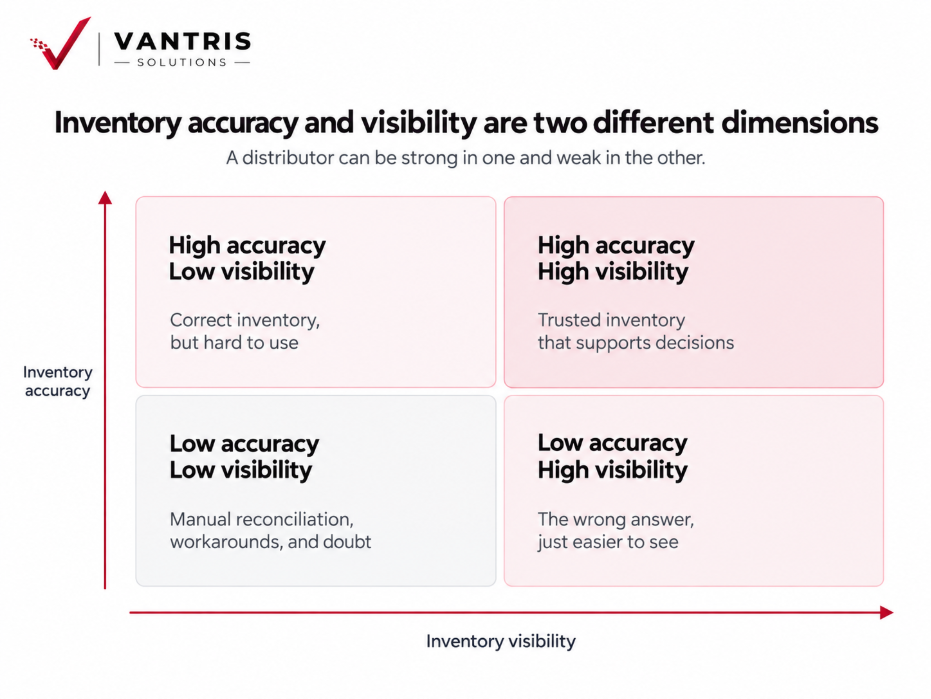
Figure 1. Accuracy and visibility are separate dimensions. Strong inventory operations need both.
What Is Inventory Accuracy?
Inventory accuracy is the degree to which system records match the physical quantity, location, and status of inventory.
So, if the ERP shows 120 units of an item in Warehouse A, Bin 03, and a physical count finds 120 usable units there, the record is accurate at that moment.
That timing matters because inventory is constantly changing. A correct count on Monday can become inaccurate on Tuesday because of:
- A missed receipt
- An unposted transfer
- A picking or shipping error
- An incorrect adjustment
- A return that has not been assigned the correct status
The operational goal is to keep physical inventory movements and system transactions synchronized.
When goods are received, moved, picked, shipped, returned, adjusted, or restricted, the ERP should record the same event with the correct quantity, location, unit of measure, and status.
Cycle counting helps identify where those records have drifted. Oracle, for example, describes cycle counting as comparing physical quantities with system on-hand quantities and investigating resulting variances. See Oracle cycle counting documentation.
A single variance shows that a difference exists.
Repeated variances can reveal a process problem.
If the same SKU, bin, or transaction type repeatedly requires adjustment, the better question is not simply how often it counts. What process keeps causing the record to become inaccurate?
Where accuracy usually breaks
| Process point | What can go wrong | What the record looks like afterward |
| Receiving | Receipt posted late, early, or with the wrong quantity | Physical stock and ERP stock disagree for part of the day or permanently |
| Putaway | Stock is received correctly but assigned to the wrong bin | Company total may be right while picking locations are wrong |
| Transfers | Product moves before the transfer is posted | One location looks long while another looks short |
| Picking and shipping | Commitment or shipment timing does not match the physical movement | Inventory appears usable after it is already spoken for or gone |
| Returns | Returned stock sits uninspected or is restored to saleable status too early | Usable inventory is overstated or understated |
| Units and status | Case, each, hold, damaged, or quarantine status is wrong | The total can look believable while the operational meaning is wrong |
Inventory adjustments are necessary, but repeated adjustments should be treated as evidence. Correcting the balance is not the same as correcting the process that moved it away from reality.
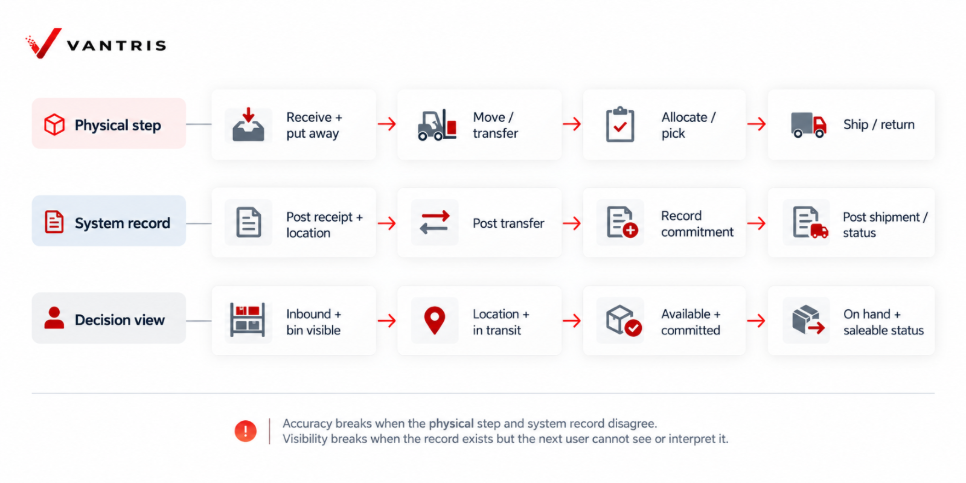
Figure 2. Accuracy is created when physical movement and system posting stay aligned. Visibility depends on exposing the resulting state to the next decision maker.
Inventory visibility begins where “on hand” stops being enough
Inventory visibility is the ability to see inventory in the context of the decision being made.
A salesperson, a buyer, a warehouse supervisor, and a CFO may all be looking at the same stock, but they do not need the same answer.
Sales want to know what can be promised.
Purchasing wants current inventory together with open supply and expected demand. The warehouse needs quantity by location and status.
Finance may care about the consolidated inventory position and value across locations.
Acumatica 2026 R1 distinguishes on hand and available quantities, supports configurable availability rules, and tracks inventory by warehouse and location. See Acumatica inventory processes.
Visibility is therefore not the same as having a dashboard. It depends on whether the data is current, understandable, available at the right level of detail, and accessible to the people who need to act on it.
On hand, available, allocated, and incoming is not interchangeable
Many inventory disagreements are really definition disagreements.
- On-hand inventory is stock recorded as physically present.
- Available inventory is the portion of that stock that can be used for new demand after business rules and commitments are considered.
For example, allocated inventory may still be physically on the shelf but already committed to another order. Incoming inventory may be relevant for purchasing or planning even though it cannot ship today.
There is no single availability formula used by every distributor or ERP system. Availability of calculations may include or exclude specific demand, incoming supply, warehouse locations, allocations, or inventory statuses.
That is why teams should agree on what “on hand” and “available” mean before using those numbers for customer promises replenishment, planning, or reporting.
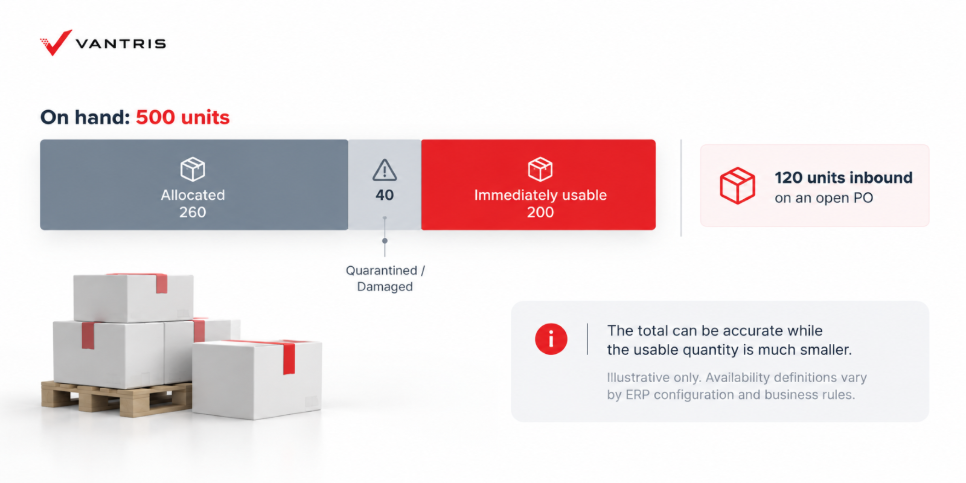
Figure 3. Hypothetical example. The company can accurately own 500 units while only 200 are immediately usable for new demand.
In the example above, the 500 unit on hand balance is not wrong.
It simply answers a different question from “what can I use right now?” The 120 units inbound on a purchase order matter to planning, but they still do not answer what can ship today.
How stock can be accurate and still hard to use
This is the part of the distinction that matters most for the article’s target question.
A distributor can maintain strong transaction discipline and still make inventory decisions slowly because the useful context is scattered across screens, reports, spreadsheets, or systems.
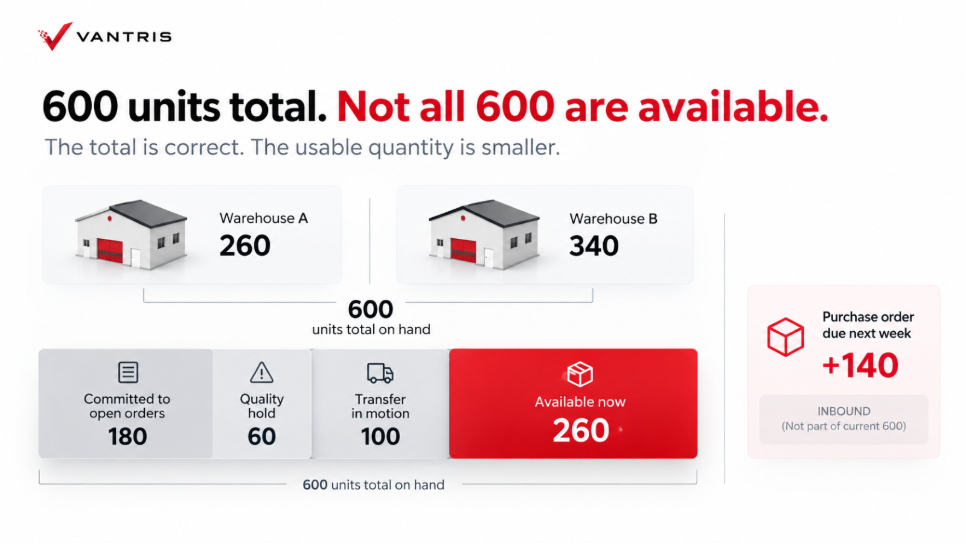
Imagine a company may have 600 units in total and still be unable to ship 150 units today.
Why? Because total inventory does not show:
- Which warehouse holds the stock
- How much is already committed to open orders
- What quantity is on hold
- What is moving between locations
- What supply is still on purchase order
If sales need 150 units from a specific warehouse this afternoon, a company-wide total does not answer the question.
The business needs to see location, availability, status, commitments, and timing together.
This is why multi-warehouse operations expose inventory visibility problems quickly. A distributor may have enough inventory overall but still miss an order because the stock is in the wrong location, committed elsewhere, on hold, or in transit between warehouses.
Different teams need different inventory views
| Team | Decision | Accuracy must provide | Visibility needs to add |
| Sales | Can we promise this order? | A trustworthy physical and transactional balance | Available quantity, commitments, fulfillment location, and expected supply |
| Purchasing | Should we replenish? | Reliable receipts, balances, and transfer records | Demand, open POs, transfers, lead time, and warehouse requirements |
| Warehouse | Where is it and what can we do with it? | Correct quantity, bin, lot or serial, and status | Task level information for receiving, picking, movement, and fulfillment |
| Finance | How much inventory are we carrying? | Reliable quantity and cost records | Consolidated views across locations, statuses, aging, and adjustments |
| Management | Where is inventory helping or hurting the business? | A trustworthy base record | Comparable views across locations, product groups, service levels, and working capital |
Trying to make one number serve every role usually produces arguments about which number is “right.” Often, several numbers are right. They are just answering different questions.
Where visibility usually breaks
Inventory visibility problems occur when the data exists, but users cannot easily turn it into a reliable answer.
Common signs include:
- Sales must call the warehouse before committing an order.
- Purchasing exports inventory and open purchase orders to Excel.
- Users cannot clearly see inventory that is in transit versus received.
- Ecommerce and ERP systems calculate availability differently.
- Management receives inventory information too late to support a decision.
- Teams use different definitions of terms such as “available inventory.”
In each case, the problem is not necessarily inaccurate transactions. The problem is that users must combine reports, spreadsheets, phone calls, or manual calculations to understand inventory status.
When those workarounds become part of the normal process, inventory visibility is an operational issue, not just a reporting issue.
Diagnostic matrix: accuracy problem, visibility problem, or both?
The quickest way to separate the two is to test the record before redesigning the report.
If a physical count does not support the system balance, start with accuracy. If the count is reliable, but the decision still requires manual reconstruction, visibility becomes the stronger suspect.
| Symptom | Likely starting point | What to check first |
| ERP says 100 units; a count finds 82 | Accuracy | Receipts, shipments, transfers, adjustments, units of measure, and location movements |
| ERP correctly shows 100; sales cannot see that 70 are allocated | Visibility | Availability definitions, allocations, permissions, and sales order views |
| Company total is right; one warehouse cannot find stock | Both | Warehouse and bin records, transfer timing, local process, and location views |
| Buyers maintain a separate “real inventory” spreadsheet | Could be either | Compare spreadsheet logic with the system and identify what they believe is missing or wrong |
| Dashboard is current but users still make poor promises | Visibility or definition | What “available” includes, what it excludes, and which time horizon the decision requires |
| Frequent inventory adjustments are normal | Accuracy | Variance patterns by SKU, bin, transaction type, and process step |
| One location has excess while another stocks out | Visibility, planning, or transfer process | Location demand, available quantity, transfer rules, and replenishment logic |
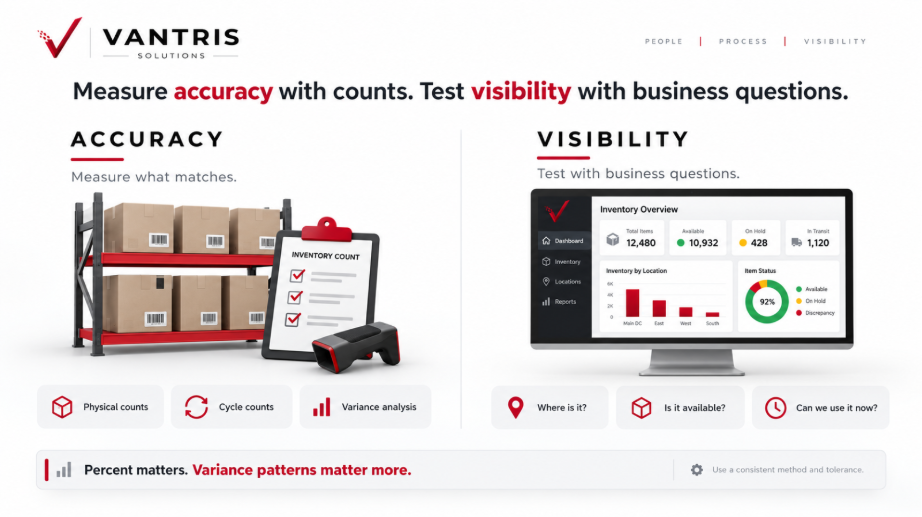
Measure accuracy with counts. Test visibility with business questions.
Inventory accuracy can be measured through physical counts, cycle counts, and variance analysis, provided that the organization uses a consistent method and tolerance.
The percentage is useful, but the pattern behind the variance is usually more valuable.
Two warehouses can report the same accuracy rate while carrying very different risks.
- One may have small random differences across slow items.
- Another may repeatedly miss the same fast-moving SKU or the same receiving location.
The headline percentage hides that difference.
Visibility is harder to reduce to a single percentage.
A more practical test is whether users can answer common operating questions quickly, consistently, and from a trusted source without manually rebuilding the data.
Ask:
- Can sales see available-to-promise inventory for the warehouse fulfilling the order?
- Can purchasing see availability alongside open purchase orders, transfers, and demand?
- Can warehouse teams distinguish between saleable, allocated, restricted, and in-transit inventory?
- Can management compare inventory across locations without combining multiple exports?
- Can users explain why on-hand and available quantities differ?
- Can users trace an unexpected quantity back to the transactions or allocations that created it?
A strong inventory review should also confirm where each number comes from, how it is calculated, who owns the process, and how often the information is updated.
Sales, purchasing, warehouse, and finance should be able to interpret the same inventory figures without relying on separate definitions or unofficial spreadsheets.
If answering these questions requires exporting several reports, combining spreadsheets, or asking another department to reconcile the numbers, the data may exist, but inventory visibility is still limited.
Why this matters for replenishment
Inventory replenishment depends on both accuracy and visibility.
Reorder points, safety stock, forecasts, and planning recommendations start from inventory and demand data. If receipts are late, transfers are missing, or quantities are wrong; the planning logic starts from a false position.
Visibility matters because planners also need the wider supply picture: what is on hand, what is committed, what is already on order, what is moving between warehouses, and where the shortage sits.
For the replenishment logic itself, see Safety Stock vs. Reorder Point: What Distributors Need to Know Before Setting Inventory Rules.
A planning engine does not become smarter because it has more screens. It becomes useful when the inputs are trustworthy, and the supply picture is visible enough for planners to understand what the recommendation is reacting to.
What an ERP system should contribute
When I look at an ERP problem, I want to separate what the system is failing to represent from what the process itself is producing. A new platform can help with the first. It does not automatically cure the second.
For accuracy, an ERP system should support controlled transaction flows for receiving, location movement, shipping, returns, adjustments, physical counting, and lot or serial tracking where the business needs it.
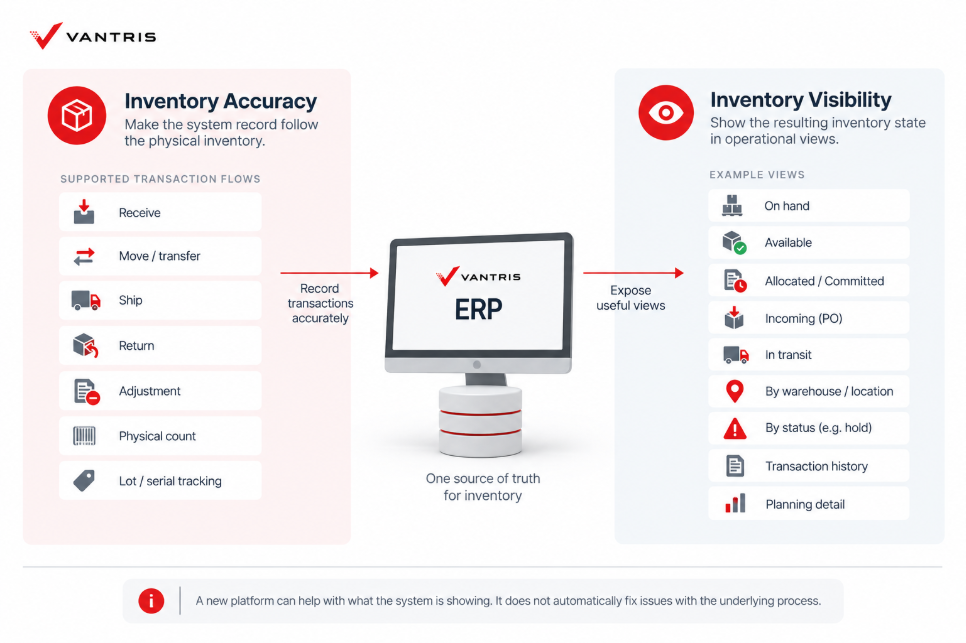
The point is to make the system record follow the physical inventory with as little ambiguity as possible.
For visibility, the ERP should expose the resulting inventory state in useful operational views.
Depending on the business, that can include on hand, available, allocated, incoming, transit, warehouse, location, status, transaction history, and planning detail.
Acumatica 2026 R1 provides inventory availability data, configurable availability rules, multiple warehouses and locations, allocation of information, transaction history, and inventory planning capabilities. See the Acumatica Inventory Management Guide.
The system should also reduce the need for parallel versions of inventory to truth.
If sales, purchasing, the warehouse, and ecommerce all calculate availability independently, the business has a definition and architecture problem as much as a reporting problem.
Questions to ask before blaming the ERP
| Question | Why it matters |
| Do physical counts regularly agree with system quantities? | If not, the first issue is accuracy regardless of how good the reporting looks. |
| Are receipts, shipments, transfers, returns, and adjustments posted close to the physical event? | Timing gaps create both record errors and confusing visibility. |
| Do users agree on what on hand, available, allocated, and incoming mean? | Different definitions can make valid numbers appear contradictory. |
| Can inventory be viewed by the dimensions that change a decision? | Warehouse, location, status, allocation, and inbound supply may matter more than the company’s total. |
| Are important inventory facts trapped in spreadsheets or another system? | That points to integration, workflow, or system of record issues, not necessarily a counting problem. |
| Can users trace a suspicious number back to transactions and commitments? | Diagnosis becomes faster when the system makes the number more explainable. |
| Would a new ERP receive the same item data and the same operating habits? | If yes, replacing the platform may move the problem rather than solve it. |
A practical sequence for improving both
Accuracy and visibility are easier to improve when the work happens in the right order. A useful sequence is:
- Define clear inventory terms so everyone understands how each type of inventory should be recorded and used
- Check if the inventory in the system matches the actual physical stock and identify any differences
- Find which business process is causing repeated inventory errors such as receiving transfers picking or shipping
- Identify what inventory information each department needs to make better and faster business decisions
- Find where inventory information is delayed separated or manually handled across different systems and spreadsheets
- Set up the ERP and system integrations based on agreed inventory rules to improve accuracy and consistency
- Regularly review inventory issues such as stock differences in stockouts and manual adjustments to prevent repeated problems.
The aim is not to have a more impressive inventory screen. It is inventory that is trustworthy enough to run the business and visible enough to use without detective work.
Accuracy tells you whether the number is true. Visibility tells you whether it is useful.
Distributors need both because inventory problems rarely affect only one dimension.
If the record is wrong, sales, purchasing, replenishment, and finance are working from a bad baseline. If the record is accurate but buried behind delayed reports, inconsistent definitions, separate systems, or the wrong level of detail, the business can still make poor decisions.
The practical test is not whether an ERP includes an “inventory visibility” feature. It is whether the business can answer important inventory questions quickly, consistently, and from data user’s trust.
In a practical inventory review, that means checking both sides of the problem:
- whether physical movements are being recorded correctly
- whether users can see the right quantity, location, status, commitments, and timing
- whether teams use consistent definitions
- whether exceptions can be traced back to the transactions that created them
If recurring inventory issues are difficult to classify, the problem may be inventory accuracy, visibility, process design, ERP configuration, or a combination of all four.
Vantris can help review the current environment and identify where those gaps are occurring before the business makes a larger ERP or system decision.
You may also want to read Replenishment Problems: How to Tell Whether the Issue Is Forecasting, Purchasing, or ERP.