
A purchase order can be perfectly accurate and still be the wrong purchase.
That makes more sense once you separate the transaction from the decision behind it.
Replenishment planning determines what to buy, when it is needed, how much is required, and where the supply should come from. A purchase order is one way the business executes that decision.
For distributors, both sides matter. A team can create clean purchase orders, follow approvals, and receive inventory correctly while still buying too much of the wrong stock.
The reverse can happen too: the replenishment logic may be sound, but orders are released late, quantities are changed, or supplier constraints are managed outside the system.
I tend to think of it this way: replenishment planning is the decision layer; the purchase order is the execution layer.
This guide explains how the two processes differ, how they connect, and how to tell whether a purchasing problem starts upstream in replenishment planning.
Purchase Order vs. Replenishment Planning
| Question | Purchase order | Replenishment planning |
| What problem does it solve? | Formalizes and controls a purchase from a vendor. | Determines what supply action is needed to keep inventory aligned with demand and policy. |
| Primary question | What are we buying from this vendor, under what terms, and when should it arrive? | What item needs to supply, how much is needed, when is it needed, and where should it come from? |
| Typical inputs | Vendor, item, quantity, price, promised date, ship to location, terms, and approvals. | Inventory position, demand, existing supply, lead time, safety stock, reorder point, forecasts, warehouse rules. |
| Typical output | A supplier facing purchasing documents. | A recommendation or planned supply action, which may become a purchase order or transfer. |
| Time focus | The specific transaction is being placed and fulfilled. | Current and future supply needs depend on the planning method. |
| Can it work alone? | Yes, but the buyer still needs some way to decide what to order. | Yes, as analysis, but recommended supply eventually needs execution through a PO, transfer, or other supply document. |
Acumatica 2026 R1 treats these as connected but distinct layers. Its replenishment process can determine whether stock needs replenishment and in what quantities, while its purchase order functionality creates and manages the actual purchasing document.
More advanced inventory planning can also generate planned orders that are later converted into purchase or transfer orders.
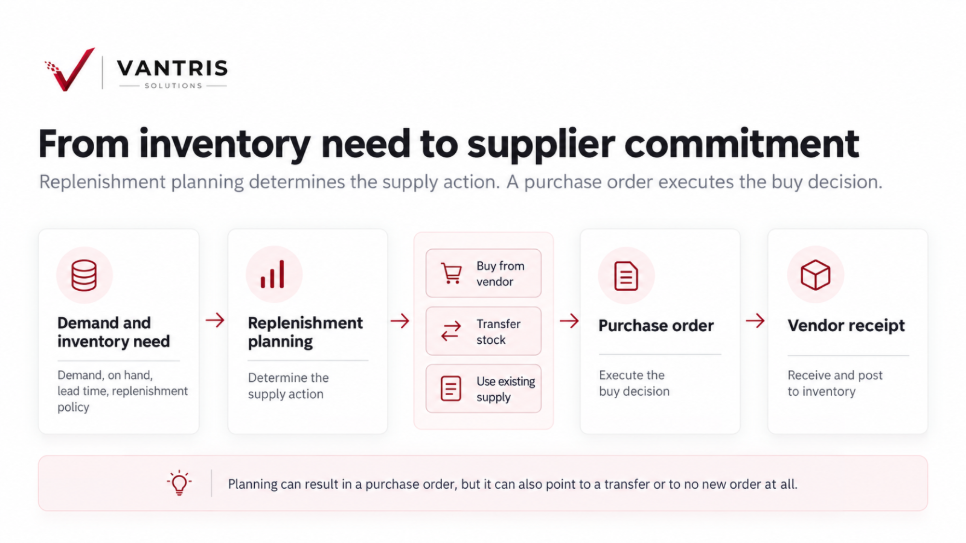
Figure 1. Replenishment planning determines the supply action. A purchase order is the transaction used when the chosen source is a vendor.
What a purchase order solves
A purchase order is an execution document.
Once the business decides to buy, the PO records that commitment in a form the buyer, supplier, receiving team, and finance team can follow. It typically captures the vendor, item, quantity, cost, delivery location, dates, terms, and approval status.
From there, the PO supports the purchasing process through approval, vendor communication, receiving, matching, and billing.
Acumatica 2026 R1 supports operational controls, including purchase order creation, approvals, promised-date tracking, receipts, and document completion.
But good execution does not guarantee a good buying decision.
A buyer can place a flawless order for 1,000 units and still create excess inventory if the demand assumption was wrong. A supplier can deliver exactly on time, and the business can still stock out if the order should have been placed three weeks earlier.
Purchase order accuracy tells you whether the transaction was executed correctly. Replenishment planning tells you whether the business made the right purchasing decision in the first place.
What a purchase order does not decide
| Question | Why the PO alone is not enough |
| Do we need to buy this item now? | The PO records the decision after somebody, or some planning logic has decided that supply is needed. |
| How much should we buy? | The entered quantity may come from replenishment logic, buyer calculation, a spreadsheet, a sales order, a blanket release, or another source. |
| Should we buy or transfer? | A multi warehouse distributor may already have usable stock elsewhere. |
| Will existing purchase orders already cover the need? | Planning should consider open supply before another order is added. |
| Is the need temporary or structural? | The document does not explain whether demand is seasonal, exceptional, or part of a new pattern. |
What replenishment planning solves
Replenishment planning sits upstream. It tries to keep inventory in a useful range by comparing demand and supply against the policies the business has set for an item or warehouse.
Depending on the method, those policies can include reorder points, safety stock, minimum and maximum quantities, demand forecasts, service expectations, lead times, order quantities, and sourcing rules. The output is not necessarily a PO. The output is a supply decision.
Acumatica 2026 R1 can calculate or apply replenishment parameters from forecast information and use its Prepare Replenishment process to show whether an item needs replenishment and in what quantity.
For more advanced planning, its Distribution Requirements Planning functionality uses time phased demand and supply and generates planned orders that can later be converted into purchase or transfer orders.
The mechanics behind reorder points and safety stock are covered in more depth in Safety Stock vs. Reorder Point: What Distributors Need to Know Before Setting Inventory Rules.
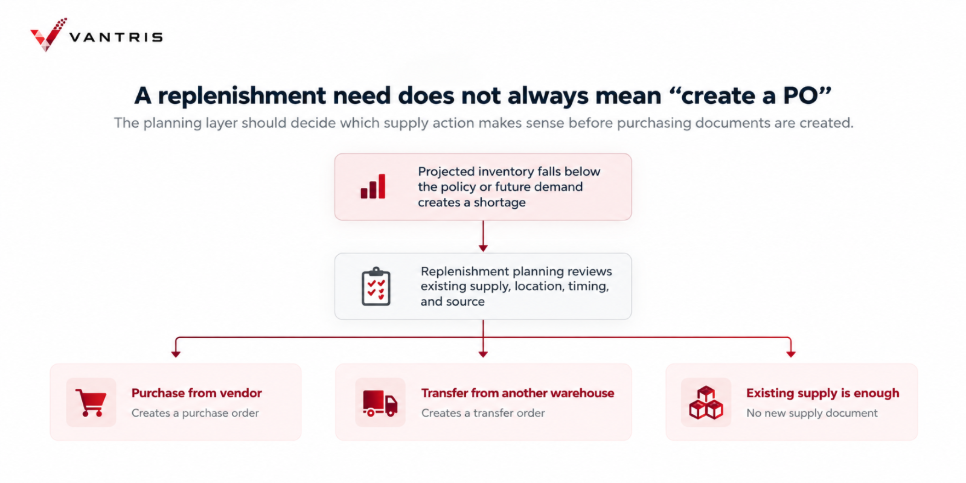
Figure 2. Planning should determine the source of supply before a purchasing document is created. The correct answer may be a purchase, a transfer, or no new order.
One item, two very different questions
Consider a distributor running short on a fast-moving component at one warehouse. The buyer sees inventory dropping and knows the supplier needs several weeks to deliver.
But the real question is not simply “Should we create a purchase order?”
The business first needs to understand upcoming demand, available inventory, open supply, stock at other warehouses, supplier lead time, and the replenishment policy for that item.
Suppose the planning process determines that 500 additional units are needed by October 15, and the preferred vendor is the right source.
At that point, the planning decision is made. Purchasing can take over and execute it.
| Planning decision | Purchase order execution |
| Need 500 additional units. | Order quantity is entered as 500 units or adjusted for the approved purchase unit and vendor constraints. |
| Supply is required by October 15. | The buyer confirms the requested or promised date with the vendor. |
| Preferred source is Vendor A. | Vendor A and the correct vendor location are placed on the PO. |
| Destination is the Toronto warehouse. | The ship to location is recorded on the order. |
| Existing open supply was already considered. | The PO becomes the new committed supply and should now be visible to planning. |
The planning layer explains why the order exists. The PO makes the order executable.
A good purchasing process cannot rescue a bad plan
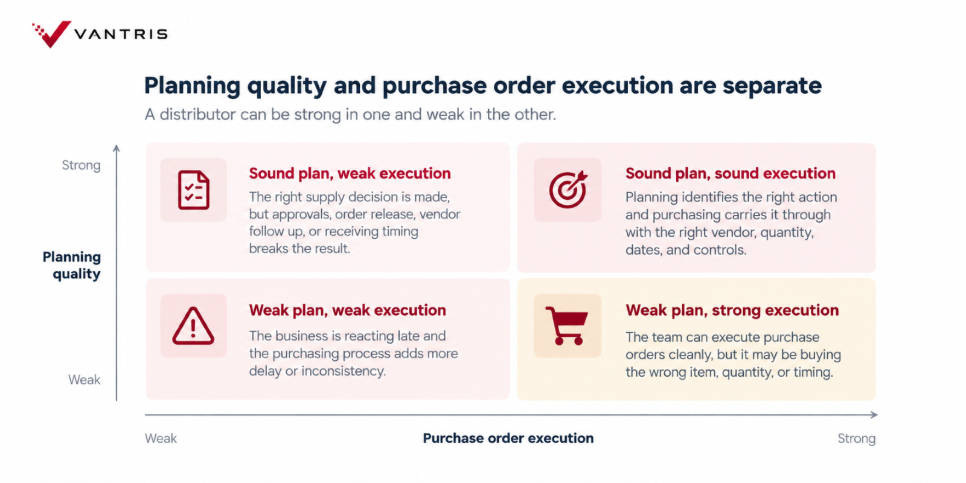
Figure 3. Planning quality and PO execution quality should be reviewed separately. Efficient purchasing can still execute a poor inventory decision very efficiently.
This is where distributors sometimes misdiagnose the problem. The purchasing team may be measured on whether orders are approved, sent, acknowledged, and received properly. Those measures matter, but they do not answer whether the business ordered the right stock at the right time.
The opposite problem is just as real.
A planning engine can produce a sensible recommendation, but an approval delay, manual quantity change, vendor minimum, freight consolidation decision, or missed promised date can undermine the result after planning is complete.
Signs the problem is in replenishment planning
A planning problem usually appears before the PO is created.
The buying team may be executing exactly what the current rules tell them to do, but the rules or inputs do not match the operation.
| Symptom | What to investigate upstream |
| Frequent emergency purchase orders | Reorder points, lead times, safety stock, forecast assumptions, and whether demand changes are reaching the planning process. |
| Excess inventory even though POs are accurate | Order recommendations, maximum quantities, demand history, order multiples, and whether existing supply is being considered correctly. |
| The same items are repeatedly short | Item level planning parameters, stockout distorted demand, supplier lead time variation, and warehouse specific policies. |
| One warehouse buys while another holds excess | Visibility across locations, transfer rules, replenishment source, and whether planning is warehouse specific. |
| Buyers maintain a private spreadsheet to decide quantities | Whether the ERP planning logic is incomplete, stale, hard to trust, or not aligned with how buyers actually work. |
If replenishment is repeatedly breaking and the team cannot tell whether the cause is demand, purchasing, master data, or ERP configuration, the related Replenishment Problems diagnostic guide is the better place to diagnose the sequence.
Signs the plan is reasonable but purchase order execution is weak
If the recommended supply action makes sense, but inventory still arrives late, in the wrong quantity, or through the wrong process, the failure is further downstream.
| Symptom | What to inspect in purchasing |
| Recommended orders sit for days before release | Approval workflow, buyer workload, review cadence, and ownership. |
| PO quantity is regularly changed after planning | Vendor minimums, pack sizes, freight economics, price breaks, and whether those constraints belong in the planning data. |
| Promised dates are unreliable | Vendor communication, confirmation process, lead time maintenance, and follow up. |
| Receipts do not match what planning expected | Partial receipts, substitutions, short shipments, receiving timing, and whether supply status is updated quickly. |
| Buyers consolidate orders manually | Whether purchasing economics are being balanced against service and inventory cost in a repeatable way. |
The point is not to defend the planning system or blame purchasing. It is to locate the decision that failed. Otherwise, the business can spend months tuning reorder points when the real delay is an approval queue or replace an ERP system when the actual issue is supplier lead time data that nobody owns.
Replenishment planning can be simple or time phased
The phrase “replenishment planning” covers more than one level of sophistication. A distributor with stable demand may use straightforward reorder point or min and max logic.
Another business may need to plan supply by future dates because demand, lead times, transfers, kits, or seasonal changes make a single threshold too blunt.
| Planning approach | Useful when | What it produces |
| Reorder point or min and max | Demand is reasonably stable and the business can manage inventory with threshold based rules. | A replenishment requirement when inventory falls below the policy. |
| Forecast based replenishment | Historical demand and service targets are useful inputs for calculating suggested inventory parameters. | Suggested safety stock, reorder point, maximum quantity, or replenishment quantity. |
| Time phased inventory planning / DRP | The business needs to see demand and supply by future period and react to date specific shortages or changes. | Planned purchase or transfer orders and exceptions that can later become supply documents. |
Acumatica describes its inventory planning functionality as time phased planning that matches supply demand using date specific recommendations.
Planned orders are potential supply orders that can be converted into purchase or transfer orders. That separation is useful because it keeps the recommendation visible before it becomes a transaction.
Multi warehouse distribution makes the distinction even more important
In a single-location business, replenishment often leads directly to purchasing.
In a multi-warehouse operation, that can be the wrong assumption.
A shortage in Calgary does not necessarily mean the company needs to buy more from a supplier. Toronto may have available stock. A central distribution warehouse may be the intended source. Inventory may already be in transit.
The planning process should consider those options before creating a new supplier commitment.
Acumatica 2026 R1 supports replenishment through a distribution center, allowing inventory to be purchased centrally and transferred to destination warehouses as needed.
That is why purchasing screens alone are a weak place to manage a network-wide inventory decision.
The purchase order sees the vendor transaction. Replenishment planning needs to see the network.
Both processes depend on inventory data the business can trust
Replenishment planning is only as useful as the inventory, demand, lead time, and open supply data behind it.
So, if a PO was received physically but not posted, the planner may think supply is still outstanding. If inventory exists in another warehouse but is not visible to the team, purchasing may create another order unnecessarily.
That is where Inventory Accuracy vs. Inventory Visibility: Why Distributors Need Both connects directly to purchasing. Accuracy tells you whether the record reflects reality. Visibility determines whether that reality is available in the context of the buying decision.
A planning process can look sophisticated and still produce poor recommendations if the underlying inventory position is stale. A purchase order then makes that poor recommendation official.
What an ERP should connect between planning and purchasing
The value of ERP is not simply that it has a purchase order screen and an inventory screen. The useful question is whether the planning decision and the purchasing transaction remain connected.
| ERP evaluation question | Why it matters |
| Can the system show why an item needs replenishment? | Buyers should be able to understand the demand, inventory, policy, or shortage behind the recommendation. |
| Does planning consider existing open supply? | A new PO should not be created simply because the system ignored what is already on order. |
| Can the recommended source be purchased or transfer? | Multi warehouse distributors need more than vendor purchasing. |
| Can buyer constraints be represented? | Minimum order quantities, order multiples, purchase units, preferred vendors, and lead times affect execution. |
| Does the PO feed back into the supply picture? | Once a purchase is committed, planning needs to recognize the incoming supply. |
| Can date changes and late supply be surfaced? | A purchase order that exists but will arrive too late may not solve the shortage. |
| Can users review recommendations before committing? | Automation is more useful when the business can understand and govern the decision. |
I would be cautious about evaluating purchasing software only by how quickly it can generate a PO. Speed helps the business know what it wants to buy. It does not answer whether the order should exist.
Which problem are you actually trying to solve?
| If your question sounds like this… | Start here |
| Why did we order too much of this item? | Replenishment of planning, demand assumptions, order policy, and quantity rules. |
| Why was the order never sent to the vendor? | Purchase order workflow, approval, ownership, or communication. |
| Why did we buy while another warehouse had stock? | Replenishment source, multi- warehouse visibility, and transfer planning. |
| Why is the supplier saying a different quantity or date? | Purchase order details, acknowledgement, and vendor communication. |
| Why does the system keep recommending emergency purchases? | Lead time, reorder point, safety stock, demand, forecast, or inventory accuracy. |
| Why is incoming supply missing from the plan? | Integration between purchasing status, receipts, and inventory planning. |
Planning is decided. Purchasing commits.
Purchase orders and replenishment planning are part of the same process, but they do different jobs.
Replenishment planning decides what supply is needed, when, how much, and from where. A purchase order executes the supplier’s commitment.
If the wrong quantity is recommended, look upstream at planning. If the recommendation is right but the order is late or changed, look at purchasing execution. If both are working from bad inventory data, fix the data first.
For distributors, the goal is a clean handoff from inventory need to supply decision to supplier commitment.
Vantris can help identify whether recurring purchasing problems sit in replenishment logic, inventory data, purchasing workflow, or ERP configuration.