
A distributor can invest in a customer ordering portal and still receive most of its largest orders through EDI.
That does not necessarily mean the portal has failed.
The two channels may serve different customers and different ordering requirements.
A smaller customer may want to check pricing, review available inventory, and place an order without contacting sales. A national retailer may already have purchasing systems that generate orders automatically and require suppliers to exchange documents through EDI.
Both customers are buying from the same distributor. But they do not need the same ordering experience.
That is why choosing between a B2B customer portal and EDI ordering is not simply a technology comparison. The better question is how customers place orders, what information they need, and how those transactions should move into the ERP.
This guide explains where each approach fits, what can go wrong, and what distributors should consider before investing in either channel in 2026.
B2B Customer Portal vs. EDI Ordering: The Main Difference
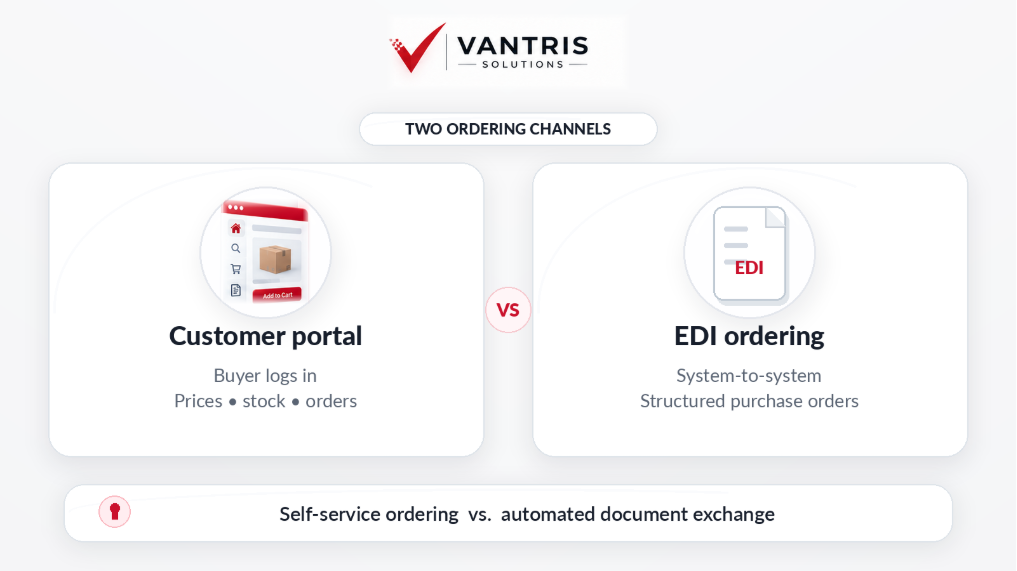
A B2B customer portal is a customer-facing application where authorized buyers can interact with a distributor directly. Depending on the portal, customers may browse products, view account-specific pricing, check inventory availability, place orders, and review their account history.
EDI, or electronic data interchange, supports the structured exchange of business documents between organizations. Rather than entering an order through a website, a customer’s purchasing system can send a standardized electronic purchase order to the distributor.
| Comparison | B2B Customer Portal | EDI Ordering |
| Primary purpose | Customer self-service | System-to-system business transactions |
| Order entry | Buyer uses a web interface | Customer system sends structured documents |
| Typical customers | Businesses wanting online ordering access | Organizations with established purchasing systems |
| Product information | Interactive catalogues, pricing, availability | Structured product and transaction data |
| Order frequency | Suitable for occasional or frequent manual orders | Particularly useful for recurring automated transactions |
| Customer onboarding | User accounts, permissions, account setup | Trading partner mapping, testing, document requirements |
| Main operational risk | Incorrect pricing, inventory, access, or order synchronization | Rejected documents, mapping errors, missing acknowledgements |
Neither approach automatically produces a better order. The difference is how the customer interacts with the distributor and how the transaction is created.
What a B2B Customer Portal Solves
A customer portal gives buyers access to information and ordering functions without requiring every interaction to pass through sales or customer service. Consider a distributor supplying replacement parts to contractors.
Customers may place orders at different times, purchase different combinations of products, and need to check availability before confirming quantities.
A portal can make transactions easier. Depending on its capabilities, customers may be able to:
- View their negotiated prices and product catalogue.
- Check inventory availability by warehouse.
- Create orders and repeat previous purchases.
- Review order status and shipment information.
- Access invoices and account documentation.
The value is not simply that customers can order online. It is that routine transactions can happen without repeated emails, telephone calls, or manual order entry. However, putting a portal in front of customers does not automatically make the underlying information reliable.
If customer-specific pricing is maintained separately from the ERP, the portal may display incorrect prices. If inventory updates are delayed, customers may order quantities the distributor cannot fulfill. The interface may be convenient while the process behind it remains disconnected.
What EDI Ordering Solves
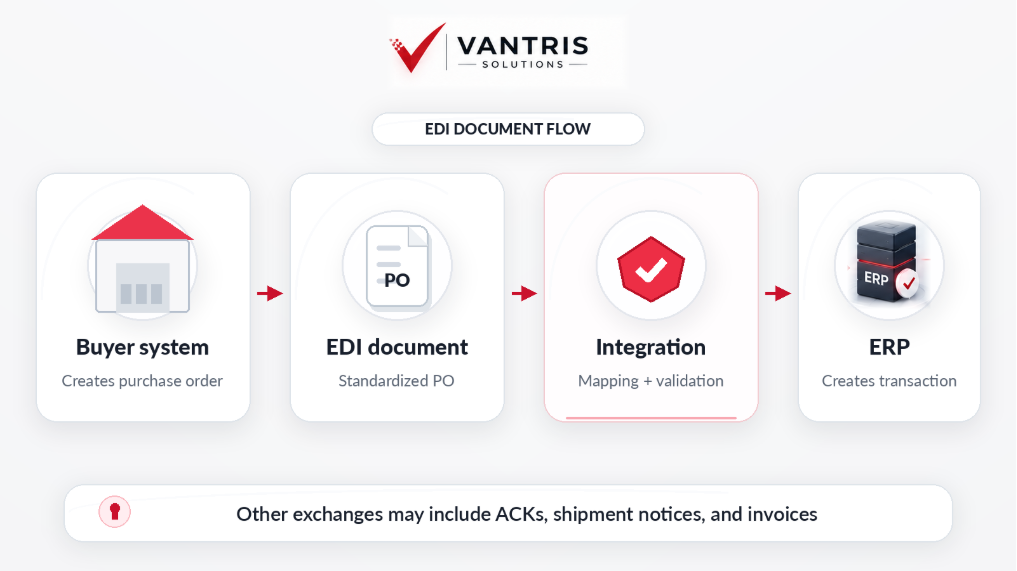
EDI is designed for structured business communication between trading partners. A large customer may generate a purchase order from its purchasing system and transmit that order electronically to the distributor.
The distributor’s integration processes the document and creates the corresponding ERP transaction, subject to validation and business rules. The exchange may continue through purchase-order acknowledgements, advance ship notices, and invoices.
For example, common X12 transaction sets include:
| EDI Document | Business Purpose |
| 850 | Purchase order |
| 855 | Purchase order acknowledgement |
| 856 | Advance ship notice |
| 810 | Invoice |
These transaction types are documented by X12’s supply chain transaction framework. EDI is useful when customers already operate structured purchasing processes and expect suppliers to participate. For those customers, asking employees to enter the same orders manually into a supplier portal may introduce unnecessary work.
But EDI has its own requirements. Trading partners need to agree on document formats, identifiers, required fields, acknowledgements, and exception handling.
A technically successful document transfer does not necessarily mean the ERP accepted the order correctly.
Why a Customer Portal Is Not Always an EDI Replacement
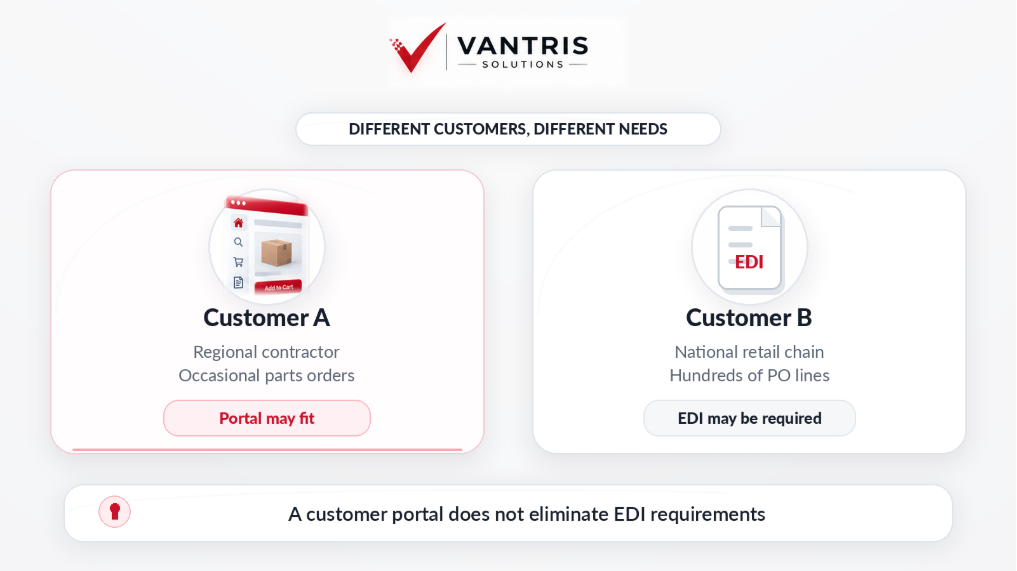
Distributors sometimes approach this decision as though one channel should replace the other. That assumption can create problems. Imagine a distributor serving two different customer groups.
Customer A is a regional contractor ordering replacement parts several times a month.
Its purchasing process is relatively straightforward. Employees want to see prices, check stock, and place orders when needed.
A customer portal may be the right fit.
Customer B is a national retail chain submitting hundreds of purchase order lines through its centralized purchasing system.
It requires electronic acknowledgements, shipment notices, and invoices in specific formats. A portal does not eliminate those trading requirements. The distributor may need EDI regardless of how capable its online ordering platform becomes. The important distinction is between customer self-service and automated document exchange.
A business can need both.
Where B2B Portals Commonly Break Down
The most visible portal problems often appear in the interface. Customers cannot find products, prices look wrong, or orders do not appear immediately. But the underlying causes may be elsewhere.
Customer-Specific Pricing Is Not Consistent
Distributors frequently manage negotiated pricing, contract terms, discounts, and customer-specific product lists. If the portal applies different pricing rules from the ERP, sales and finance may need to correct orders manually. That is not simply a website problem. It is a question of which system owns the commercial rules.
Inventory Availability Is Misleading
A portal may display 100 units because that is the current on-hand quantity. But 70 units may already be committed to other orders. Customers can then place orders based on inventory that is not actually available for new demand.
The broader distinction is covered in our article on inventory accuracy vs. inventory visibility. A portal needs availability information appropriate to the customer commitment being made, not just a quantity copied from an inventory screen.
Orders Do Not Reach the ERP Reliably
If an order is accepted by the portal but fails during ERP synchronization, the customer may believe the transaction is complete while the warehouse has nothing to fulfill. The integration needs a clear process for order validation, rejection, retry, and status confirmation. Otherwise, the portal creates another place where employees must investigate missing transactions.
Where EDI Ordering Commonly Breaks Down
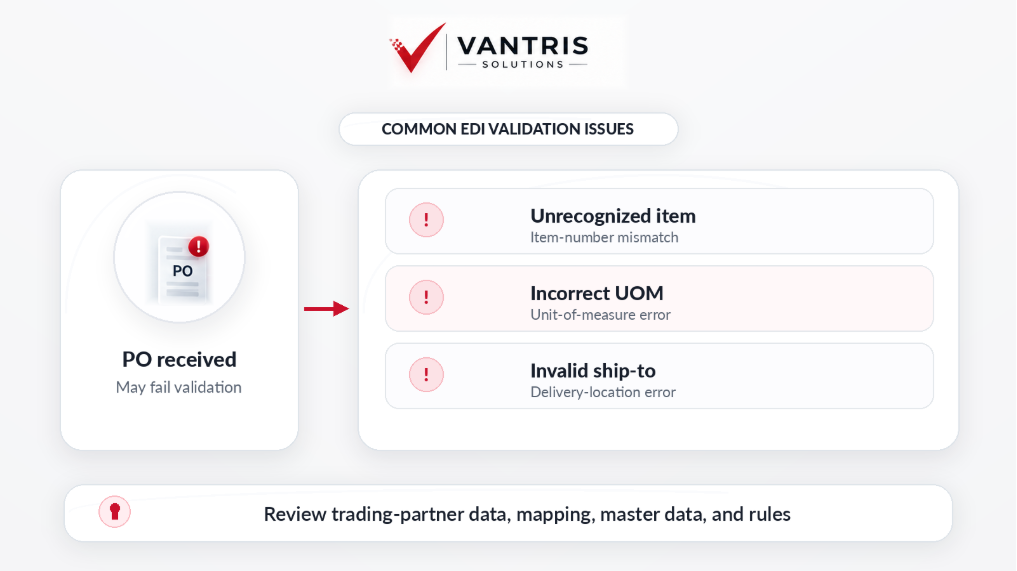
EDI problems tend to be less visible to customers until a document fails, or a commitment is missed. A purchase order might be transmitted successfully but rejected because the customer used an unrecognized item number. Another document may contain the wrong unit of measure or an invalid delivery location. The issue could originate with the trading partner, the document mapping, the ERP master data, or the order validation rules.
Before blaming the EDI platform, determine where the transaction stopped.
| Symptom | What to Investigate |
| Customer says an order was sent, but ERP has no order | Transmission, acknowledgements, translation, and import errors |
| Incorrect product appears on an order | Customer item mapping and internal item master |
| Order quantity is wrong | Unit-of-measure conversion and document mapping |
| Shipment notice is rejected | Required fields, timing, shipment data, and partner specifications |
| Invoice does not match the customer order | Pricing, quantities, document references, and ERP transaction data |
EDI requires ongoing operational ownership. Trading partner requirements change. New customers need testing. Exceptions need monitoring. A successful initial integration does not eliminate those responsibilities. Our guide to EDI vs. API vs. flat-file integration explains the underlying exchange methods and where each introduces different operating requirements.
How Distributors Should Choose in 2026
The decision should begin with customer ordering behaviour rather than software features. A useful review asks five questions.
1. How Do Customers Currently Place Orders?
Determine what percentage of orders arrive through email, telephone, sales representatives, online channels, and EDI. Also review the transaction volume and complexity associated with each channel. A small number of EDI customers may account for a large proportion of order volume.
2. Are Customers Asking for Self-Service or Automation?
Customers who want easier access to catalogues, pricing, and order history may benefit from a portal. Customers seeking to eliminate manual purchasing transactions may prefer EDI or require it through their trading agreements. These are different requirements.
3. What Does the ERP Need to Control?
Regardless of ordering channel, the business should define which system owns customer accounts, pricing, inventory, sales orders, fulfillment status, and financial transactions. If the portal and EDI environment maintain conflicting versions of the same information, adding channels increases complexity.
4. Who Will Handle Exceptions?
A portal needs support for failed submissions, incorrect account access, and unavailable products. EDI needs monitoring for missing, rejected, or incorrectly processed documents. Both require named process owners and clear recovery procedures.
5. What Will It Cost to Maintain?
Initial implementation is only part of the investment. Portal maintenance can involve customer support, security, catalogue management, and application integrations. EDI maintenance can involve partner onboarding, mapping changes, testing, transaction monitoring, and service fees. Compare ongoing operating requirements, not just software subscription prices.
Why Many Distributors Will Need Both
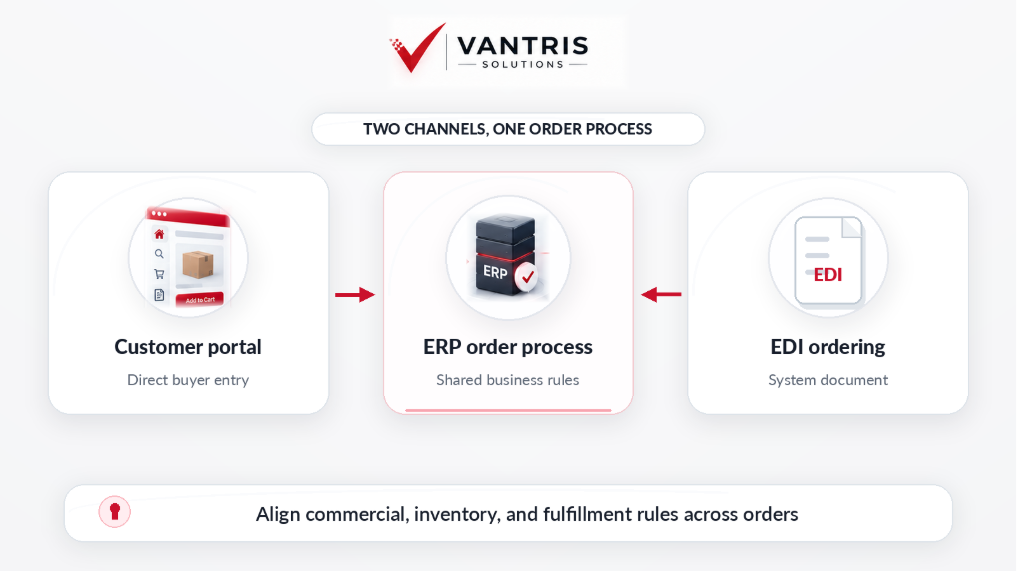
For a growing distributor, the practical answer may be to support both channels within one consistent order management process. A customer portal provides an accessible ordering experience for buyers who want to interact directly.
EDI supports customers that expect automated business-document exchange. The ERP should receive and process those orders according to consistent commercial, inventory, and fulfillment rules. That does not mean every integration must work identically.
It means the business should understand where each order originated, whether it was accepted, what inventory was committed, and how fulfillment will proceed. The objective is not to make every customer order through the same interface. It is to prevent different ordering channels from producing different versions of the business.
If you need a portal, EDI or both connected to your ERP, see our Acumatica integration services and how Acumatica supports distributors.
Frequently Asked Questions
Can a B2B portal replace EDI?
For customers that place occasional orders, review product availability, or need access to negotiated pricing, a portal may provide everything they need. It allows buyers to work directly with the distributor without exchanging structured documents between purchasing systems. The situation changes when customers have established procurement systems that generate purchase orders automatically or require electronic acknowledgements, shipping notices, and invoices.
Is EDI better for high-volume orders?
EDI is often well suited to customers that submit frequent, high-volume orders through established purchasing systems. It can reduce repetitive order entry and support structured communication between trading partners. However, order volume alone does not determine whether EDI is the better option.
A distributor might receive hundreds of relatively simple orders through a customer portal and process them efficiently. Another distributor may receive fewer but more complex transactions from a large retail customer that requires EDI compliance.
Can distributors use a portal and EDI with the same ERP?
Yes. A distributor can support B2B portal orders and EDI transactions within the same ERP environment, provided both channels follow consistent business rules. For example, a contractor might submit an order through a customer portal while a national retailer sends its purchase order through EDI. Both transactions may need to use the same ERP item records, customer pricing rules, inventory availability calculations, and fulfillment processes.
The Right Ordering Channel Depends on the Customer
A B2B portal and EDI ordering solve different operating problems. A portal helps customers interact with the distributor directly. EDI supports structured transactions between business systems. Neither one automatically corrects poor inventory data, inconsistent pricing, or unreliable order processing.
Before investing in either channel, distributors should identify what customers need, which transactions require automation, and where the ERP must remain in control.
The better decision is not necessarily to choose one technology over the other. It is to build an ordering process that works for the customers the business actually serves. Vantris Solutions can help distributors review their current ordering channels, ERP integrations, and fulfillment workflows to identify where disconnected processes are creating unnecessary work.
Talk to Vantris about your current environment and what needs to work better.