
Lot tracking and serial tracking solve the same broad problem at different levels: they help a distributor identify inventory after it has entered the business.
The practical difference is the level of identity.
Lot tracking groups units under a shared batch or lot number. Serial tracking gives each physical unit its own identifier.
That sounds like a small configuration choice.
It changes how receiving works, what warehouse staff need to capture, how returns are investigated, how recalls can be scoped, and how much transaction detail the ERP system must preserve.
In this guide, we’ll look at the operational difference, the products that commonly fit each model, the tradeoffs in day-to-day inventory work, and the questions to answer before configuring lot or serial tracking in ERP.
Lot tracking vs. serial tracking briefly
| Question | Lot tracking | Serial tracking |
| What gets identified? | A group of units that share the same lot or batch identity. | One specific physical unit. |
| Typical reason to use it | Batch traceability, expiration management, quality history, recalls by production group. | Unit level history, warranty, service, ownership, high value assets, recalls or investigation by exact unit. |
| Warehouse data burden | The lot and quantity must be preserved through relevant inventory transactions. | Each serial number must be captured and preserved for the individual unit. |
| Can expiration be relevant? | Yes. Lot controlled products commonly use expiration dates. | It can be. Some ERP systems can also track expiration by serial class. |
| Does regulation automatically decide it? | No. Applicable rules may require lot codes, unique identifiers, control numbers, or other records depending on the product and jurisdiction. | No. Serial tracking should be based on the actual traceability requirement, not an assumption that more granular always means more compliant. |
GS1 describes the distinction in terms of identification levels: batch or lot level identification separates one group of units from another, while instance level identification identifies one individual product instance.
The business objective and supply chain determine which level is appropriate.
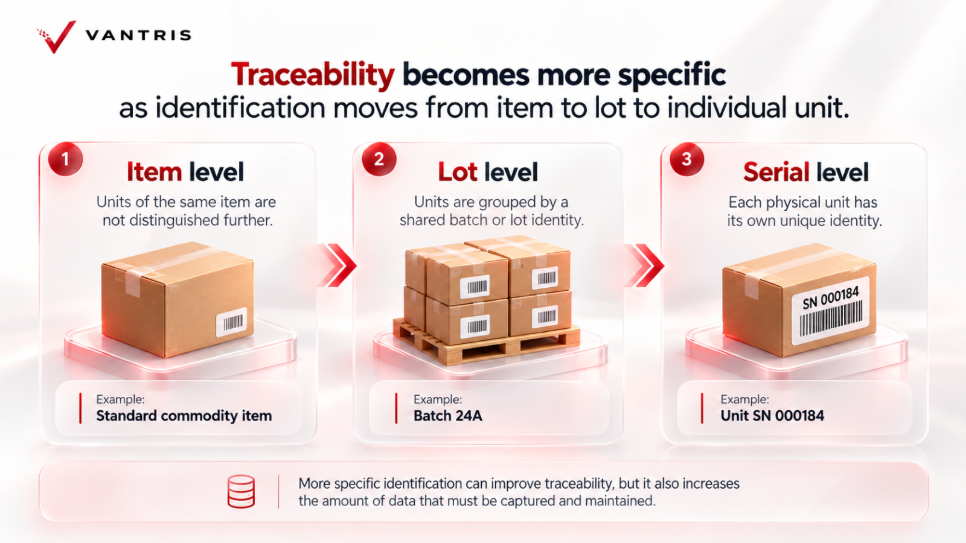
Figure 1. Tracking granularity moves from identifying the product type, to identifying a group, to identifying one individual unit. The more specific the identity, the more transaction detail the operation must preserve.
Lot tracking answers: which group did this unit come from?
Lot tracking is useful when many units share a characteristic that matters to traceability.
That characteristic might be a production run, supplier batch, manufacturing date, quality result, expiry period, or another condition the business needs to preserve.
For a distributor, the key idea is that the units inside the lot remain interchangeable for traceability purposes.
If 200 bottles arrived at Lot A17, the system needs to know how many units from A17 are on hand, where they are, and which customers ultimately received them.
It does not necessarily need a separate identity for bottle 1, bottle 2, and bottle 3.
Products that commonly fit a lot of based approaches include food, ingredients, chemicals, consumables, and other goods where an issue is more likely to affect a batch than one isolated unit.
The exact requirement depends on the product and operating environment, so the product example should not be treated as a regulatory rule.
What lot tracking changes operationally
Lot tracking becomes useful only when a lot of relationships survive the transactions that matter. Receiving may capture the supplier lot.
Putaway needs to preserve which quantity belongs to which lot.
Transfers need to move the right lot. Picking and shipping need to record which lot left the warehouse. Returns and adjustments need the same discipline.
If those steps are incomplete, the business can technically “have lot numbers” while still struggling to answer the question that matters during an investigation: where did this lot go?
Serial tracking answers: which exact unit is this?
Serial tracking goes one level deeper. Every tracked unit has a unique serial number, so two otherwise identical products can be distinguished from each other throughout inventory activity.
That level of detail becomes useful when the history of one unit matters independently of the others.
Common examples include equipment, electronics, appliances, specialized parts, and other products where warranty, service, ownership, installation history, or unit specific investigation matters.
If a distributor sells ten identical pieces of equipment, serial tracking can preserve which customer received each one.
If one unit later returns for service, the business can work with the history of that exact unit rather than treating all ten as one batch.
Serial tracking creates more discipline at each transaction
The benefit of unit level identity comes with more operational work. Receiving may need to capture ten serial numbers for ten units.
Transfers need to preserve those ten identities. Shipment confirmation needs to know which serial went to which order. Returns need to capture the same unit coming back.
That additional detail is valuable when the business uses it. It is simply extra friction when nobody needs unit level history.
Chart 1. Hypothetical example showing how more specific identification can narrow the initial investigation scope when the affected identifier is already known. This is illustrative only, not a recall benchmark or regulatory rule.
More granular tracking is not automatically better
Serial tracking gives the business a more precise identity, but precision has a cost. More identifiers must be scanned, entered, validated, stored, transferred, and reconciled.
Warehouse exceptions can become more difficult because the system cares not only that ten units moved, but which ten units moved.
The same principle works in the other direction. Lot tracking is lighter than serial tracking, but it may not be specific enough when warranty or service depends on one individual unit.
A useful design does not maximize data collection. It captures the level of identity the business can justify and operate consistently.
Some products can reasonably fit either approach
The product name alone does not always decide the answer. Two distributors can sell similar equipment and need different tracking.
One distributor may only need to identify which production batch supplied as a part. Another may provide after-sales service and need the serial number of every installed unit.
A supplier may provide both a manufacturing lot and an individual serial number. The ERP design then needs to decide which identifiers the distributor will actually capture and use.
That is why “electronics are serialized” or “food is lot tracked” works as a rough example, not as an implementation rule.
Regulatory requirements should be checked, not assumed
Traceability is often discussed as though regulation automatically dictates one tracking method. The reality is more specific.
For example, the Canadian Food Inspection Agency states that certain food businesses subject to the Safe Food for Canadians Regulations must maintain traceability records, and certain consumer prepackaged foods must carry a lot of code.
The rules contain scope and exceptions, so that should not be simplified into “all food distributors must use lot tracking in ERP.”
Health Canada’s medical device labelling guidance gives another useful example.
For Class III and Class IV devices, a control number is required that can be used to determine manufacturing, packaging, labelling, or distribution history for a unit, lot, or batch.
That wording itself shows why a compliance requirement should not automatically be translated into “use serial numbers for every medical device.”
I would resist turning a regulatory assumption into an ERP design rule without checking the actual requirement, the product, the customer obligation, and the records the business must be able to produce.
The safer implementation question is: what must we be able to identify, prove, retrieve, and act on if there is a quality issue, recall, warranty case, customer dispute, or audit?
Expiration tracking is related, but it is not the same decision
Lot numbers and expiration dates are often mentioned together because many expiring products are managed by batch.
They are still separate pieces of information.
The lot identifies the group.
The expiration date tells the business when the relevant inventory expires. Depending on the product and ERP configuration, expiration can be associated with lot tracked or serial tracked inventory.
Acumatica 2026 R1, for example, allows a lot or serial class to use lot tracking, serial tracking, or no tracking, and separately includes a setting to track expiration dates for tracked classes.
That distinction matters when a distributor is deciding whether it needs to batch identity, expiry control, unit identity, or some combination of those capabilities.
Traceability has to survive the warehouse workflow
Figure 2. Lot and serial identifiers only create traceability if the relevant identity survives in the inventory transactions that move the product through the business.
This is where the design moves from a master data decision into an operating process.
If lot or serial capture adds several steps at receiving, but nobody updates the identifier correctly during transfers or returns, the system can still produce gaps.
If warehouse staff regularly bypass scanning because the workflow is too slow, the theoretical traceability design may be stronger than the actual one.
The system and the warehouse process need to agree when the identifier is required, who captures it, and what happens when it is missing or incorrect.
Lot and serial tracking also affect inventory visibility
A distributor may know that it has 50 units of an item without having enough information to make the next decision.
With lot tracking, the useful question may become: how many of those 50 units belong to each lot, which lot expires first, and where is each lot stored?
With serial tracking, the useful question may be: which 50 serial numbers are available, which are already allocated, and which customer or service record is tied to each unit?
That is why this topic connects closely to Inventory Accuracy vs. Inventory Visibility. the total quantity and can be accurate while the traceability detail needed by purchasing, warehouse, customer service, or quality teams is incomplete.
What Acumatica supports
Acumatica 2026 R1 supports inventory items that are not tracked, tracked by lot number, or tracked by serial number through lot and serial classes.
Those classes provide default settings for items and can also support expiration of date tracking.
Acumatica documentation also allows organizations to define numbering rules and to work with lot or serial numbers provided by vendors.
Optional lot and serial attributes can store additional characteristics against a lot or individual serialized unit.
The capability is useful, but the configuration still needs an operating decision behind it.
Enabling serial tracking because it offers more detail can create work that the business never uses. Choosing lot tracking because it is easier to leave gaps if one unit must be traced independently.
The ERP should preserve the level of identity the business has decided it needs. It should not be asked to make that decision by itself.
A practical decision path
Figure 3. A practical starting point for choosing tracking granularity. Regulatory, customer, supplier, warranty, and contractual requirements still need to be verified separately.
The decision tree is deliberately simple.
It is meant to start the conversation, not replace product specific requirements.
If the exact unit matters, serial tracking is the natural place to investigate. If units are interchangeable but their batch, production, quality, or expiration history matters, lot tracking is usually the stronger starting point. If neither is relevant, item level inventory may be enough.
Then test that answer against the real process.
Questions to answer before configuring lot or serial tracking
- What event are we trying to investigate later: a batch issue, an individual unit issue, or both?
- Do suppliers already provide lot or serial numbers, and are those identifiers reliable and machine readable?
- Does the identifier need to be captured at receipt, shipment, transfer, return, drop shipment, service, or all of those points?
- Do expiration dates matter separately from the tracking number?
- Will warehouse staff scan identifiers, enter them manually, or receive them electronically?
- Does sales or customer service need to know which customer received a particular lot or serial number?
- Does the business need attributes or additional information tied to the lot or individual unit?
- What happens when a supplier sends an incorrect, duplicate, or missing identifier?
- Which customer, contractual, industry, or regulatory requirements apply to this specific product?
- Can the current ERP and warehouse process preserve the identifier without creating workarounds outside the system?
A useful tracking design should make an investigation easier
The real test is not whether the item master says “lot tracked” or “serial tracked.”
The test is whether the business can answer questions that appear when something changes.
Which inventory is affected by? Where is it now? Which customer received it? What came from the same batch? Which exact unit came back? Is the product still within its usable date?
Lot tracking is usually the better fit when the shared history of a group matters. Serial tracking is usually the better fit when the history of one-unit matters. Neither should be selected simply because it feels more sophisticated.
If your team is reviewing ERP inventory management and trying to decide what level of traceability belongs in the system, start with the business event you need to reconstruct later. Then design the data capture around that requirement.
Vantris can help you review those requirements and determine what your ERP system needs to support.
For lot and serial traceability inside the ERP, see Acumatica for manufacturing and Acumatica for distribution.
About Harvey Wang
Harvey Wang is President of Vantris. Harvey brings more than 15 years of experience across ERP, professional services, investment management, and executive recruitment. Before Vantris, he led growth in the Sage ERP ecosystem and worked closely with businesses evaluating technology, operations, and investment decisions. Across those roles, his focus has been consistent: turn complex information into clear business decisions.
At Vantris, Harvey leads growth, client strategy, partnerships, and go to market. His approach to ERP starts with how the business makes money, where performance is being held back, and what needs to improve before deciding what role technology should play. Clients do not need a mirror of the way they already work; they need a partner who can help separate what is unique from what is simply habit.