
A distributor can have years of sales history and still struggle to predict what customers will order next month.
Some products sell consistently. Others move in large, irregular quantities. Seasonal demand, changing customer requirements, supplier delays, and new product introductions can make historical patterns difficult to interpret.
Traditional forecasting methods have helped distributors plan around these conditions for decades. Now, AI-based forecasting tools can identify patterns, incorporate additional variables, and automate parts of the forecasting process.
But do that mean distributors should replace traditional forecasting with AI in 2026?
Not necessarily.
The better forecasting approach depends on the products being planned, the quality of available data, and how the forecast will influence purchasing decisions.
This guide compares AI demand forecasting with traditional methods, explains where each works best, and outlines what distributors should evaluate before changing their forecasting process.
What Is Traditional Demand Forecasting?
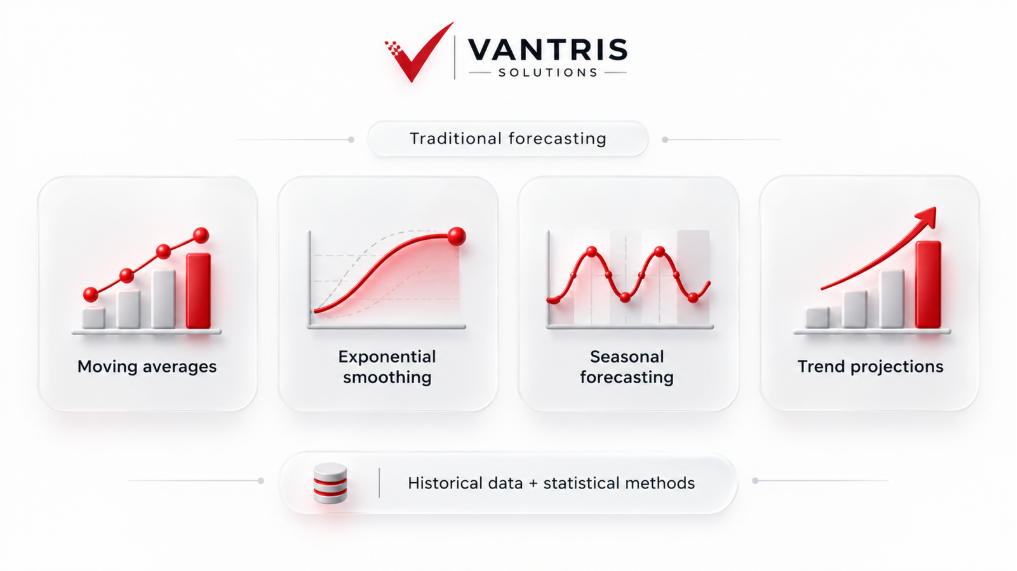
Traditional demand forecasting uses historical information and established statistical methods to estimate future customer demand. Common approaches include moving averages, exponential smoothing, seasonal forecasting, and trend-based projections.
A distributor might calculate average monthly sales over the previous six months and use that figure to plan upcoming purchases. For products with relatively stable demand, this can work well. More advanced statistical methods can also account for trends and recurring seasonal patterns without requiring machine learning.
The main advantage is that these methods are generally easier to understand, maintain, and explain. Purchasing teams can review the historical figures, understand the assumptions, and adjust when conditions change.
However, forecasting becomes harder when demand is irregular or influenced by several changing factors. A simple historical average may not recognize that a major customer has reduced its purchasing; a project has ended, or demand has shifted between locations.
What Is AI Demand Forecasting?
AI demand forecasting uses machine learning and related analytical techniques to identify relationships in historical and, where available, additional business data. Rather than relying only on predefined formulas, machine learning models can learn patterns from multiple variables.
Depending on the solution, these may include customer ordering behaviour, product categories, seasonality, pricing changes, promotions, and external demand indicators.
For example, an AI-based model may recognize that demand for a particular product increases when several conditions occur together.
That relationship might be difficult to identify through a simple moving average. AI can also help automate forecasting across large product catalogues. However, AI forecasting is not the same as asking a generative AI assistant to predict next month’s sales. A dependable forecasting process requires suitable models, historical testing, data preparation, and ongoing performance monitoring.
AI can improve the analysis, but it does not remove the need for planning judgment.
AI vs. Traditional Forecasting: Key Differences
| Comparison | Traditional Forecasting | AI Demand Forecasting |
| Main approach | Statistical rules and historical patterns | Machine learning and learned relationships |
| Data requirements | Often manageable with limited history | Typically benefits from larger, cleaner datasets |
| Complexity | Usually easier to configure and explain | Can require more technical oversight |
| Changing demand | Depends on method and adjustments | May recognize complex changes when adequately trained |
| Forecast transparency | Often relatively straightforward | Varies by model and explanation tools |
| Maintenance | Periodic review and recalibration | Monitoring, retraining, and data governance |
| Best fit | Stable demand and straightforward planning | Complex patterns where testing demonstrates additional value |
The comparison is not about which technology is newer. It is about which approach produces forecasts the business can use reliably.
Where AI Forecasting May Offer an Advantage
Managing Large Product Catalogues
Distributors managing thousands of SKUs often cannot review every forecast manually. AI-based systems may help identify unusual demand patterns, produce forecasts across product groups, and direct attention toward items requiring intervention. This can be useful when demand differs across warehouses or customer segments. However, additional forecasting complexity should be justified by measurable improvements.
Recognizing Multiple Demand Influences
Historical sales do not always explain why demand changed. A product may sell more frequently because of seasonal work, customer projects, promotional activity, or changes in purchasing behaviour. When reliable information about these factors is available, machine learning may identify relationships that simpler approaches are missing. The benefit depends on whether the information is genuinely predictive and available when the forecast is created.
Supporting Exception-Based Planning
One practical use of AI is identifying situations that deserve closer review. Instead of asking buyers to inspect every SKU, a system might highlight significant demand changes, unusual purchasing patterns, or forecasts with greater uncertainty. This allows employees to concentrate on exceptions rather than repeatedly reviewing stable items.
When Traditional Forecasting Still Makes More Sense
Traditional methods remain useful, particularly where demand is predictable, and planning requirements are straightforward. Consider a distributor selling a standard replacement part. The product has consistent monthly demand, a dependable supplier, and limited seasonal variation.
A well-configured statistical forecast may be sufficient. Adding a more complex AI model might not improve purchasing decisions enough to justify its cost and maintenance.
Traditional approaches may also be preferable when historical data is limited, or the business needs easily explainable calculations.
Slow-moving products create another challenge.
A SKU that sells only a few times annually may have insufficient observations for certain forecasting models. Specialized intermittent-demand methods may be more appropriate than either a basic average or a general-purpose AI model.
The important point is that forecasting methods should match demand behaviour, not simply the size of the technology investment.
A Practical Example: Forecasting a Seasonal Product
Consider a distributor supplying equipment used primarily during warmer months.
Historical sales show:
| Period | Average Monthly Demand |
| January–March | 80 units |
| April–June | 180 units |
| July–September | 220 units |
| October–December | 100 units |
These illustrative figures show a recurring seasonal pattern. A simple annual monthly average would forecast 145 units, potentially understating summer demand and overstating winter demand.
A traditional seasonal forecasting method could handle this pattern effectively. An AI model might provide additional value if demand also varies with weather, customer projects, regional activity, or other relevant signals.
But that improvement is not automatic. If those additional signals are unreliable, the more complex forecast may be worse.
The distributor should test both approaches against actual historical outcomes before changing its planning method.
Why Data Quality Matters More Than the Forecasting Label
A sophisticated forecast cannot reliably correct every problem in the underlying data. Distributors should understand what their sales history actually represents. For example, recorded sales may understate demand when products are unavailable, and customers cannot place or complete orders.
One-time project orders may distort historical averages. Returns, warehouse transfers, incorrect units of measure, and discontinued items can create additional problems.
Before changing forecasting tools, review whether the data reflects genuine customer demand.
Our guide to inventory replenishment problems explains how forecasting issues can become difficult to distinguish from purchasing, inventory configuration, and ERP problems.
This distinction matters.
Changing the forecasting method will not resolve incorrect lead times or purchase orders that are consistently released too late.
How Distributors Should Evaluate Forecasting Methods
Rather than selecting AI or traditional forecasting across the entire inventory catalogue, distributors can evaluate methods by product group.
1. Segment Products by Demand Behaviour
Identify stable, seasonal, intermittent, and highly variable items. Start with products where forecasting errors carry meaningful financial or service consequences. ABC inventory analysis can help prioritize items by value, although demand variability and operational importance should also influence the selection.
2. Establish a Traditional Forecasting Baseline
Choose an appropriate statistical method and measure its performance. Without a baseline, it is difficult to know whether an AI solution genuinely improves results.
3. Test Both Methods Against Historical Outcomes
Use previous periods to simulate forecasts made before actual demand became known. Compare accuracy over multiple periods and planning horizons rather than relying on one successful result. The time-series cross-validation approach explained in Forecasting: Principles and Practice provides a useful foundation for this evaluation.
4. Measure Operational Results
Forecast accuracy alone is not enough. Distributors should also examine forecast bias, stockouts, excess inventory, emergency purchasing, and service-level performance. A more accurate forecast is valuable when it leads to better decisions.
5. Review the Cost of Maintaining the Process
Consider software, integration, data preparation, training, and ongoing monitoring. A modest forecasting improvement may not justify a disproportionately expensive implementation.
What Should ERP Systems Support in 2026?
Forecasting should not operate separately from the processes it is intended to improve. The ERP needs reliable connections between demand history, inventory positions, supplier information, purchasing rules, and replenishment recommendations.
For example, Acumatica’s 2026 R2 release expanded embedded AI and modern analytics capabilities across the platform.
Distributors should verify the forecasting functions supported by their ERP version, configuration, and any additional planning applications. Our guide to ERP inventory management systems examines the inventory controls needed to support connected operations.
The objective is to make forecasts usable within purchasing and replenishment workflows, rather than maintaining predictions in a separate report nobody acts on.
So, Which Forecasting Approach Should Distributors Choose?
For many distributors, the most practical answer is a combination. Traditional forecasting can handle products with stable, understandable demand patterns. AI-based methods may be worth evaluating for product groups with more complex demand relationships, provided sufficient data and clear performance benefits exist.
Human review remains important for exceptional customer orders, new product introductions, and business changes that historical data cannot adequately explain. In 2026, the goal should not be to replace traditional forecasting simply because AI is available.
It should be to build a forecasting process that is accurate enough, maintainable, and connected to purchasing decisions.
To see how forecasting and replenishment fit into a distribution ERP, read about Acumatica for distribution and our implementation approach.
Frequently Asked Questions
Is AI demand forecasting more accurate than traditional forecasting?
Not always. AI may outperform traditional methods when complex relationships and suitable data are present. Simpler statistical methods can perform equally well or better for stable demand. Historical testing is necessary.
Can small distributors use AI forecasting?
Yes, depending on their data quality, product complexity, budget, and available software. However, a smaller distributor may benefit more from improving existing inventory and forecasting processes before introducing additional technology.
Does AI forecasting replace purchasing teams?
No. Forecasting estimates of demand. Purchasing teams still manage supplier relationships, lead times, minimum order quantities, exceptions, and commercial decisions.
Can AI forecasting eliminate stockouts?
No. Stockouts may result from supplier delays, inventory inaccuracies, ordering constraints, or unexpected demand. Better forecasts can reduce certain risks but cannot eliminate every source of shortage.
Let’s Do a Business Review
If your forecasting process relies heavily on spreadsheets, repeated manual adjustments, or recommendations your purchasing team does not trust, it may be worth reviewing the process before investing in new tools.
Vantris Solutions helps distributors evaluate ERP workflows, inventory data, integrations, and planning requirements. Talk to Vantris Solutions about how your current systems support forecasting and replenishment decisions.