
A supplier can deliver every purchase order on time and still create inventory problems for a distributor. The quantities may be incomplete. The products may arrive damaged. Lead times may vary enough that purchasing cannot confidently plan the next order.
On paper, the supplier looks reliable.
In practice, warehouse teams are managing shortages, buyers are following up on missing quantities, and customer orders are being delayed.
That is why supplier performance cannot be measured by delivery dates alone.
Purchasing teams need to understand whether suppliers are providing the right products, in the right quantities, at predictable times, and under the agreed commercial terms. For distributors reviewing purchasing performance in 2026, these seven metrics provide a practical starting point.
The goal is not to build a larger supplier dashboard. It is to identify which supplier problems affect inventory availability, purchasing decisions, and customer fulfillment.
What Should a Supplier Performance Scorecard Measure?
A supplier scorecard should help purchasing distinguish between reliable execution and recurring exceptions.
| Supplier Performance Metric | What It Measures |
| 1. On-time delivery rate | Whether orders arrive by the agreed date |
| 2. In-full delivery rate | Whether suppliers deliver the complete quantity |
| 3. Lead time consistency | How predictable actual delivery lead times are |
| 4. Receiving accuracy | Whether received items, quantities, and units match the order |
| 5. Defect-free receipt rate | Whether products arrive in acceptable condition |
| 6. Purchase price variance | Whether actual purchase costs match agreed prices |
| 7. Issue resolution time | How quickly suppliers resolve reported problems |
These measures should be evaluated together. The ASCM SCOR Digital Standard also separates supplier reliability into dimensions such as delivery timing, quantity accuracy, product condition, and documentation. That distinction matters because a supplier can perform well in one area while creating problems in another.
1. On-Time Delivery Rate
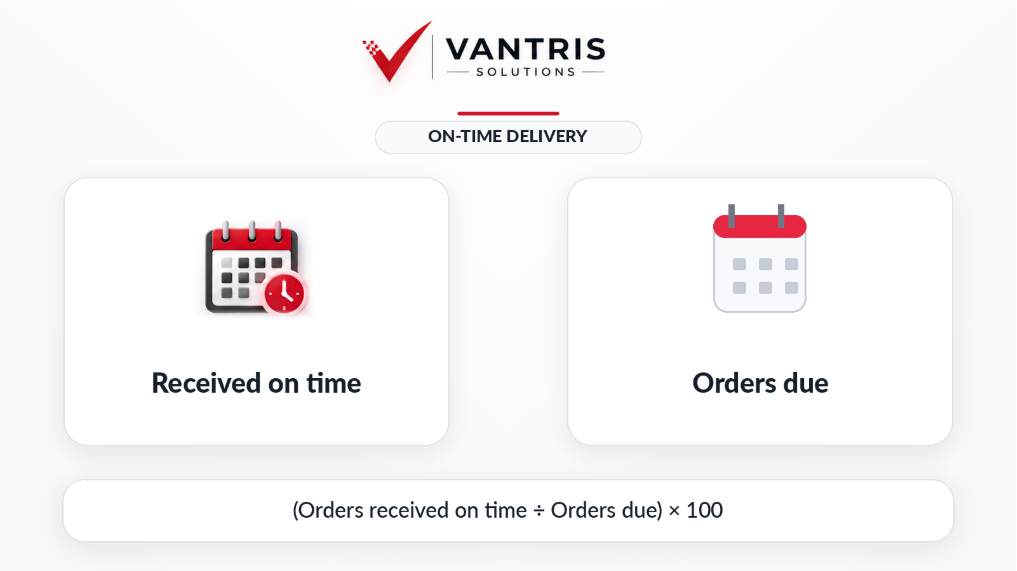
On-time delivery measures how consistent suppliers meet agreed delivery dates.
Define on-time against the original agreed commit date:
On-Time Delivery Rate = (Orders Received on or Before the Original Agreed Date ÷ Orders Due) × 100.
Suppose a supplier has 50 orders due during a month, and 42 arrive on or before their original confirmed dates.
The on-time delivery rate is 84%.
The number is useful, but purchasing should examine the circumstances behind the eight late orders. Were they delayed by two days or three weeks? Did the delays affect critical inventory? Were delivery dates changed after the original commitment?
One important control is preserving the original confirmed delivery date.
If buyers repeatedly replace the original date with a supplier’s revised promise, a supplier can appear to be performing well even while missing commitments.
2. In-Full Delivery Rate
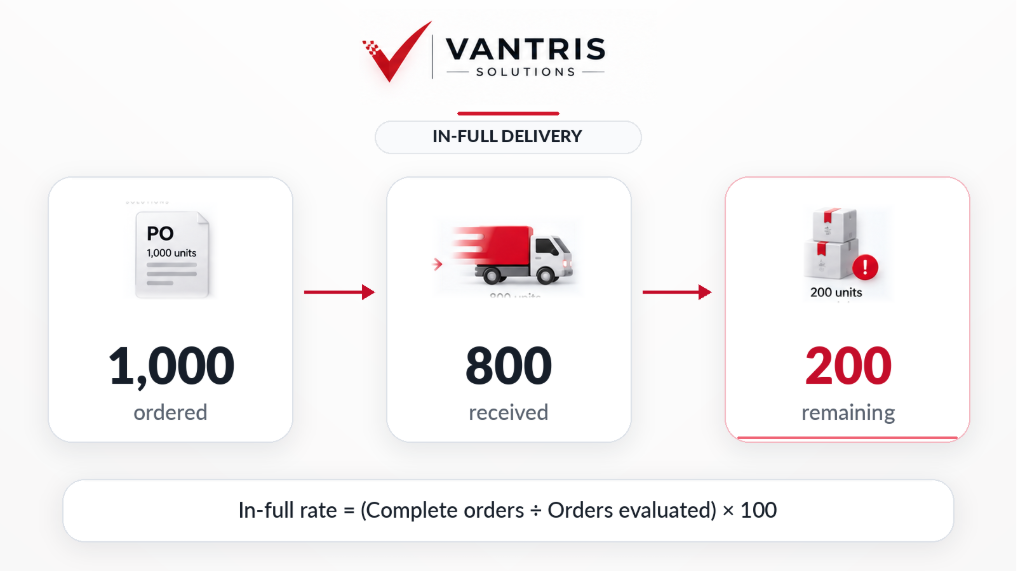
An order can arrive on time without arriving completely. A supplier may deliver 800 units against a purchase order of 1,000 units. The warehouse receives the shipment, but purchasing must still manage the remaining 200 units.
In-full delivery measures whether suppliers provide the complete ordered quantity within agreed tolerances.
In-Full Delivery Rate = (Complete Orders ÷ Orders Evaluated) × 100
Consider a supplier that delivers 95% of its orders on time but regularly ships in partial quantities. That supplier may still create shortages and additional purchasing work. Purchasing should review whether partial shipments are planned, agreed in advance, or discovered only when the warehouse receives the goods.
On-time and in-full performance can also be combined into an on-time, in-full (OTIF) measure. However, keeping the two components visible helps identify whether the problem is delivery timing, quantity fulfillment, or both.
3. Supplier Lead Time Consistency
Average supplier lead time is useful, but averages can hide significant variation. Suppose a supplier typically takes 21 days to deliver. Recent purchase orders arrived after 20, 22, 21, 35, and 20 days.
Most deliveries were close to expectations. One took considerably longer. If the ERP uses a fixed 21-day lead time, the longer delivery may create a shortage that purchasing did not anticipate. Lead time consistency measures how much actual delivery timing varies between orders.
Purchasing should compare:
- Expected lead time recorded in the ERP
- Actual time between purchase order release and receipt
- Differences across suppliers, products, and warehouses
- Frequency and size of unusually long delays
Use consistent start and end points when calculating actual lead time. Averages are helpful, but the range and frequency of longer delays may be more important for inventory planning.
If actual supplier performance no longer matches the lead times stored in the ERP, replenishment recommendations may become unreliable. Our guide to inventory replenishment problems explains how incorrect lead times can make a purchasing problem appear to be a forecasting or system issue.
4. Receiving Accuracy
A supplier may deliver the correct total quantity while still creating receiving errors. The shipment might contain the wrong product, use an incorrect unit of measure, or distribute the total quantity incorrectly across purchase order lines.
For example, the purchasing team orders 50 cases of a product, but the supplier ships 50 individual units. The delivery may look complete until receiving checks into the unit of measure. Receiving accuracy measures how consistently shipments match purchase order details.
A practical measure is the percentage of received purchase order lines with the correct item and quantity. However, not every receiving discrepancy is necessarily the supplier’s fault.
Incorrect purchase orders, product master data, or warehouse posting errors can produce similar results. Before classifying the issue as supplier performance, purchasing should compare the purchase order, supplier documentation, physical receipt, and ERP transaction.
Repeated discrepancies may indicate a supplier’s problem, but they can also reveal a weakness in purchasing data or receiving controls.
5. Defect-Free Receipt Rate
Receiving the correct quantity does not mean the inventory is usable. Products may arrive damaged, fail inspection, or not meet agreed specifications. Defect-free receipt rate measures the proportion of deliveries or order lines accepted without supplier-attributable quality problems.
For distributors handling regulated, sensitive, or traceable products, this can also involve checking documentation, lot information, and required product conditions.
The measurement should distinguish supplier defects from damage or errors introduced after delivery. Otherwise, purchasing may assign responsibility to the wrong party. A supplier with competitive prices but frequent quality problems may create additional inspection work, returns, replacement orders, and fulfillment delays.
Those costs do not always appear in a purchase price comparison. That is why quality performance should be reviewed alongside purchasing costs.
6. Purchase Price Variance
For supplier performance, compare the actual invoiced price with the agreed or purchase-order price. A standard cost can be useful for accounting analysis, but it may reflect internal costing assumptions rather than supplier compliance.
Purchase Price Variance = (Actual Unit Price − Expected Unit Price) × Quantity
Suppose a distributor expects to purchase 500 units at $40 each. The supplier invoices $43 per unit. That creates an unfavourable purchase price variance of $1,500.
Before treating the difference as supplier for noncompliance, purchasing should investigate whether the price changed because of an approved agreement, currency movement, quantity break, or another legitimate reason.
Purchase price variance also does not represent the full landed cost of inventory.
Freight, duties, handling, and other applicable acquisition costs may affect profitability even when the supplier’s invoiced unit price is correct. The useful question is whether purchasing understands the cost difference and whether it was expected.
7. Supplier Issue Resolution Time
Some supplier problems cannot be prevented completely. What matters next is how the supplier responds. Issue resolution time measures how long suppliers take to close reported problems such as shortages, incorrect shipments, quality claims, and pricing disputes.
A simple measure is the average number of days between reporting an issue and its documented resolution. But the average should not hide unresolved critical cases. A supplier that closes minor questions quickly while leaving important shortages unresolved may still create substantial operational risk.
Purchasing should record when the issue was raised, who owns it, the agreed corrective action, and when the problem was resolved.
A supplier’s acknowledgement is not necessarily a resolution. For a shortage, resolution may mean receiving the replacement quantity or agreeing on an acceptable alternative. For recurring issues, purchasing should also determine whether the corrective action prevents the same problem from happening again.
When Supplier Metrics Point to the Wrong Problem
A poor supplier score does not always mean the supplier caused the entire problem. Consider a distributor experiencing repeated late inventory receipts. The supplier may be missing confirmed dates. But purchasing may also be releasing orders later than the replenishment plan requires.
The ERP might have recommended purchasing three weeks earlier. If that recommendation remained in an approval queue, supplier performance alone does not explain the shortage.
That is why the supplier scorecard needs to connect with purchasing execution and planning information. Our article on purchase orders vs. replenishment planning explains the difference between determining when inventory is needed and executing the supplier’s purchase.
When I look at recurring purchasing problems, I would want to separate three questions:
- Did the business identify and communicate the requirements correctly?
- Did the supplier fulfill the agreed commitment?
- Did the ERP and receiving process record what actually happened?
Those are different points of failure. A supplier scorecard becomes more useful when it helps distinguish them.
What Should an ERP System Contribute?
An ERP should make supplier performance easier to evaluate using the purchasing and receiving transactions already recorded by the business. That can include purchase order dates, confirmed quantities, receipts, pricing, returns, and supplier records.
However, having the data does not guarantee a reliable scorecard. If delivery dates are overwritten, receipts are posted late, or supplier issues are tracked only in email; the reported performance may not reflect what happened.
Before adding dashboards or supplier evaluation software, review whether the existing transaction process captures the necessary information consistently. For most distributors, a smaller set of trusted supplier metrics is more useful than a detailed report built from incomplete records.
Supplier data is most useful when it lives in the same system as purchasing and receiving. See Acumatica for distribution and Acumatica for manufacturing.
Supplier Performance Should Lead to Better Purchasing Decisions
The purpose of measuring suppliers is not simply to rank them. It is to understand which relationships create operational risk, where purchasing needs better controls, and whether supplier performance is affecting inventory availability.
A low on-time delivery rate may require a discussion with the supplier. Inconsistent lead times may require updated planning parameters. Frequent receiving discrepancies may require changes to order confirmation or warehouse processes. Different findings call for different actions.
In 2026, distributors should be able to connect supplier performance with the decisions of those suppliers’ influence. The practical test is whether purchasing can explain why a supplier is considered reliable, identify where performance is changing, and act before recurring problems affect customers.
Vantris can help review purchasing workflows, supplier data, and ERP controls to determine where those gaps are occurring before the business makes a larger system decision. Contact us today